From Waitlists to Action: How to Help Your Autistic Child Today
- Katelyn Huras
- Mar 19
- 10 min read

Joey’s mom, Patty, first started to wonder about her dinosaur-loving little boy at his second birthday party.
His family gathered around a large T-Rex shaped cake enthusiastically singing “Happy Birthday to you!…” but Joey stared blankly. He showed little interest in his birthday celebration.

She felt sad and began to investigate what was going on.
Waiting for What You Don’t Want
A couple of weeks later, after many long sleepless nights comparing in her mind what she had read online about development delays to her son’s behavior, Patty made an appointment with their pediatrician.
That’s when she heard for the first time out loud what she had suspected…“autism”.

Although she feared hearing that word, she was relieved to get a referral for Joey to be formally assessed. She was desperate for professional answers about why her little boy was different.
Unfortunately, the waiting list for the assessment was over 6 months! And sadly, this is the norm.
The majority of autism diagnosticians and assessments in the United States have a waiting list of over 4 months.
And this is just to get a diagnosis, let alone starting therapy… which could be many more months, or even years, later.
While her baby boy continued to miss the neurotypical developmental milestones, Joey’s mother was left feeling helpless.
While other same-aged kids they knew were learning new words by the day, Joey still hadn’t uttered his first. And Patty hadn’t been offered any practical actions to take.
The half-a-year assessment waiting list felt like wasted time, watching her Joey fall further and further behind.
Did you know that a quick free online screening tool can score if your child is at risk for autism?
The MCHAT-R (Modified Checklist for Autism in Toddlers, Revised) is a 20 question screening - not a diagnosis - used to help identify children between 16 and 30 months old who might be at risk for autism spectrum disorder (ASD). It is a step that parents can take before they get a formal diagnosis, that identifies early signs of developmental delay and assesses the risk or likelihood that a child might have autism spectrum disorder.
No Relief
The day Patty finally received her son’s autism diagnosis, the feeling of relief, of finally having some answers, was short-lived.
At two and a half years-old, Joey was formally diagnosed with Level 3 autism, requiring “intensive support.”
Patty already knew the importance of the early development years, so being told that early intervention was critical didn’t help but increase her anxiety.
“I was told his diagnosis and handed an information booklet. And that’s it. Sent on my way” - Patty
Back at home, she stayed up almost all night for nights in a row glued to her laptop hunting for answers to the questions she didn’t remember to ask at the diagnosis.
Her first Google search for “Best Autism Treatment” returned over 100,000,000 (that’s one-hundred million) links!!

Like thousands of parents before her, she felt overwhelmed. Anxiety found a permanent home in her stomach.
She was desperately looking for a clear roadmap, at least a starting point, with steps to follow. She hadn’t come across ThriveGuide yet.
Future Fears
She continued to barely sleep most nights, laying awake thinking “What programs are most effective?”, “Which one is best for Joey right now?”, and “How will we afford all of this?”
And although she was Joey’s best advocate getting him through every single day, at times, Patty got lost in future thoughts: What if we’re past the period where he can learn and thrive? Will Joey ever be independent? What will happen to him when I’m gone?
100% of parents raising a Level 3 autistic child admit to being haunted by this last question.
And it motivates them to stretch themselves further to try almost anything. These families are vulnerable to quack remedies wrapped in hope.
“What programs are most effective? Which one is best for Joey right now?”
Intuitively, Patty kept coming back to the same conclusion: that Joey was unique, so he needed a therapy path that fit his particular constellation of needs.
His strengths and challenges were similar to other autistic kids she had read about, but also slightly different. She learned early on that there is a spectrum and no two autistic children are alike.
Famously, Dr. Stephen Shore, an Adelphi University Professor, diagnosed Aspergers, and an autism advocate once wrote,
“If you’ve met one person with autism, you’ve met one person with autism.”
Yet, all of the therapy programs on offer seemed to suggest that their approach works for all kids. She couldn’t stop wondering “Doesn’t my autistic son need a support plan as unique as he is?”
On zero hours of sleep, Patty kept searching and scrolling.
A Maze of Solutions
Google and ChatGPT lead parents to hundreds of diverse therapy options for autism, like:
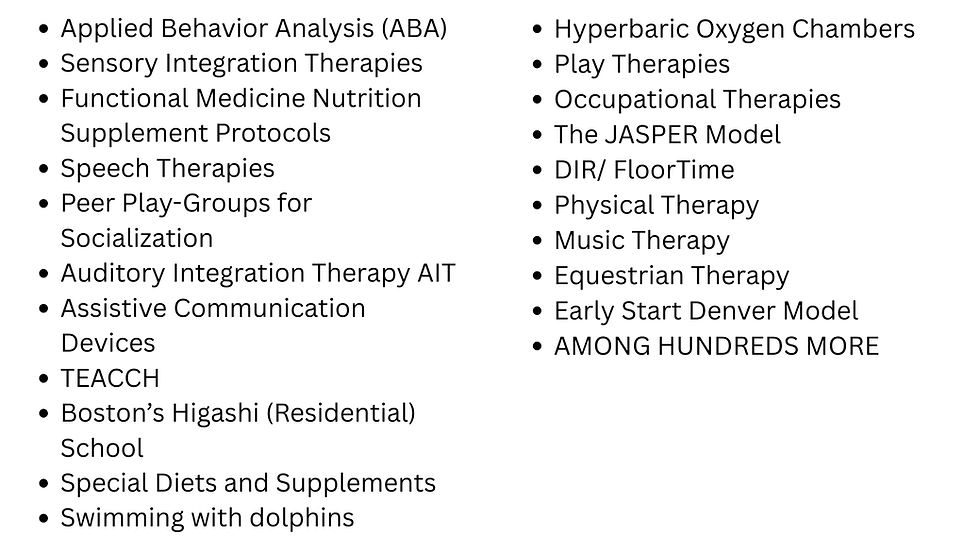
But almost none of them communicate clearly which children their approach or method works best with and which children are not ideal candidates.
Unlike medications which are labeled with “Indications” and “Contra-Indications”, so that patients are informed what the medication does and what specific symptoms it is meant for, most autism therapies seem to be open for business for any and all children on the spectrum.
And even if it is genuine, even if it’s true that a particular approach can help all children across the spectrum, this advertisement isn’t helpful for parents who are looking for a fit for their unique child.
Patty kept searching for an approach that would look at her son’s individual profile and match him to the right goals and the right strategies.
The majority of parents start with ABA therapy. This is the #1 most recommended and most-researched autism therapy in the world.
But, like many parents, Patty wondered out loud to her family and to other moms in chatgroups, “Is ABA a good fit for my child’s learning style? Is he ready for structured learning?”

No One-Size-Fits-All
Jonathan Alderson, Founder of ThriveGuide, Harvard-graduate, and 25+ years autism specialist has advocated and written about the need for the field of autism therapies to be more collaborative.

He says they should be aligned into a “map” for parents to more easily find their child’s unique path:

In an interview for this article, Alderson explained further that:
“In other words, there is no one-size-fits-all approach to autism therapy. Almost all parents come to the same conclusion pretty quickly that no single program has all of the answers… they are going to have to cobble together a multi-disciplinary team… a customized journey to fit their special child… and sadly, still today, programs and service providers continue to operate separately, leaving parents to figure out how to coordinate the different programs on their own."
Parents report that they receive contradictory advice and often feel torn between allegiance to different therapists with different approaches.
These are ongoing issues in the field that parents have to navigate.
This is why I launched the Integrative Multi-Treatment Approach over 20 years ago. And it’s why my online parent training app called ThriveGuide is so advanced – because it provides a solution for a gap that parents are stuck in today.”
A New Invention
Jonathan Alderson and his team of autism specialists saw a glaring need for parents who don’t need yet another program to choose from, but do need a clear plan: Practical action steps they can do right away, whether their child is sitting on a waiting list or already in a program.
Parents need to be empowered with more training themselves
So, based on years in-the-field designing precision autism programs, Alderson began to offer families a one-of-a-kind consultation that produced a highly customized plan of action for their autistic child.

To prepare for Alderson’s consultation, a family would first complete an in-depth intake questionnaire and submit copies of the diagnosis, SLP and school reports.
Alderson then visited the family’s home to observe-live the social and communication dynamics, to take notes on their autistic child’s behavior, as well as on the parents’ reactions and skills.
Compiling and analyzing all of this data, Alderson produced a succinct but insightful report of no more than 5 recommendations:
“Considering your child’s current needs, and considering all of the treatment programs and service options available to you, here are the best next steps that you can take for your autistic child to thrive.”
The 4-5 recommendations were very carefully put in sequence - in order of operation - that they had to be done to maximize the benefit.
Jonathan would explain how his observations connected to each of his recommendations and cited published research for parents to have confidence that the prescribed programs and strategies were evidence-based.
Parents felt relieved! For the first time, in some cases in years, they had a clear plan in hand.
Alderson called this type of consultation a “Treatment Map.”
And his consultations were in-demand. But he was only one person and couldn’t keep up with the thousands of parents who needed a clear path forward.
So, with a new mission in his heart, to reach many more thousands of families, he created an online app of the Treatment Map called ThriveGuide!

Patty, like many parents in a similar situation faced 3 big problems:
She was overwhelmed by the number of different autism therapies and didn’t know which ones were right for her son
Her autistic son Joey had been stuck on waiting lists for funded services for months wasting his valuable learning time
She didn’t have the income or savings to be able to afford expensive private ABA autism therapy
Without insurance, ABA and other private therapies can range from $60,000 to over $150,000 USD annually.
Sadly, Patty is in the majority. Thousands of parents will read this article and feel like they’re reading their own story.
Maybe this is you too?
Jonathan Alderson has sat in hundreds of families’ living rooms and kitchens hearing these same 3 big problems over and over. His mission is to provide practical solutions.
And that’s why he designed ThriveGuide as a solution for these “Big 3”:
✔ ThriveGuide tells you which strategy fits and where to start. It was designed by a team of autism specialists with a one-of-a-kind algorithm that personalizes an individualized learning plan to guide parents through the “Next best steps.”
✔ ThriveGuide has no waiting list. You can start it today and have a plan in hand within 90 minutes.
✔ ThriveGuide costs less than a single speech therapy session. At ThriveGuide, we believe ALL parents should have access to specialized evidence-based autism parent support for a cost that’s affordable for ALL.
After ThriveGuide was launched, Jonathan was interviewed on the Mom’s Talk Autism Podcast:

And he was asked to explain ThriveGuide:
“It matches your child’s unique profile of strengths and challenges to the next best step that you as the parent can take, today, to move your child’s learning forward.”
These three little words Next Best Step describe perfectly what you get with ThriveGuide – a clear practical action step to do today! And as soon as you complete that step, ThriveGuide provides the Next Best Step…and so on!
Not Another Program
Patty is not looking for yet another autism program to choose from!
But she IS looking for an autism specialist who will consider her son Joey’s unique constellation of strengths and challenges to help her make some important decisions about which goals she should be focused on and which strategies will help her to achieve them.
The ThriveGuide App is not meant to replace local ABA programs, school, or autism therapies a child is already signed-up for.
For children who currently have a full day of school and autism therapies, ThriveGuide sits comfortably in a parent’s pocket empowering them with clear “best next step” goals and daily actions so they can play an active role in accelerating their child’s growth.
For children who haven’t started school or therapy yet, or who are still on service waiting lists, or who score high-risk for autism but have yet to be diagnosed, ThriveGuide is one of the world’s top Early Learning Readiness programs.
ThriveGuide identifies the barriers in the way of a child’s learning and delivers an action plan for parents to begin to remove the barriers and replace them with learning skills, today.
More Best Days
And this is why ThriveGuide was highly recommended for Patty – even though her son Joey got his diagnosis, he was then stuck on waiting lists for autism services. Even though Patty had progressed from not knowing why her son was not developing, she still didn’t know what she should do, today, to move him forward.
So, while she waits for Joey’s name to get to the top of the wait lists for some speech therapy and for a spot in a local ABA Center, she can use ThriveGuide immediately today to get a personalized plan including developmentally appropriate goals to focus on with Joey; goals that are based on his development profile.
And what’s perfect is that the ThriveGuide goals are focused squarely on removing learning barriers that the proprietary algorithm identifies as the biggest blocks preventing Joey from being at his best - that is, barriers that are in his way of paying attention, participating in social opportunities, of communicating, of following learning, and of simply feeling good.
These are all part of what educators call “learning readiness”; being in a healthy and happy state of physical and cognitive wellbeing, being “regulated” and “receptive”.... It’s what your child is like when the teacher says to you “They had one of their best days!”
And, Patty is empowered and supported with daily bite-sized action steps! It’s like having an autism parent coach in your pocket that reminds you of your current goal and nudges you to take the best next step forward.
Step by step. ThriveGuide is a parent’s guide to removing the learning barriers that are in the way of your child having more best days!
Meet Jonathan Alderson, E.d.M

Jonathan Alderson is the Founder and CEO of ThriveGuide the world’s first online instant individualized development plans for autistic children. He is also the Director of the Integrative Multi-Treatment program for autism acceptance and development - a highly customized “precision” solution, merging behavioral, cognitive, and biological therapies, paying specific attention to order and timing. A Masters from Harvard University and an internship with the Harvard Family Research Project, led to 1500-hours of play-based therapy training over eight years at the Autism Treatment Center of America in Massachusetts. He has coached 2000 families, over 25 years, designing and directing therapy programs across Europe, Australia, Israel, Mexico and North America. He has been a keynote speaker for The Saskatchewan Ministry of Health, The Primary Elementary Teachers Association of Nova Scotia, the Royal College of Pediatricians (University of Nottingham), and the Canadian Psychiatric Research Foundation. Interviewed in the Toronto Globe and Mail, CBC radio, Breakfast Television, he also appeared in several episodes of the award-winning TV reality series Employable Me coaching adults with autism. He served as Chair of the Professional Advisory Committee of the Seneca College Behavioral Science Program, was Founding Chair of the Autism Speaks to Young Professionals Advisory Board, and former member on the Board of the Lane Montessori School for Autism. He was editor of the book Autism 101, 2nd Ed., a contributor to the HuffingtonPost, and ParentsCanada Magazine, and is the author of Challenging the Myths of Autism honored with 7 awards, including the Mom’s Choice Gold Award. In 2022 he founded ThriveGuide leveraging technology and a team of autism specialists to reach even more families, for their children to have “more best days.”


Comments